From vague idea to a scored first read in 30–60 minutes.
Validate before you build.
Pressure-test your software idea before you commit months to building it.
A staged review with DVF scoring — desirability, viability, feasibility — that ends in a decision-ready report.
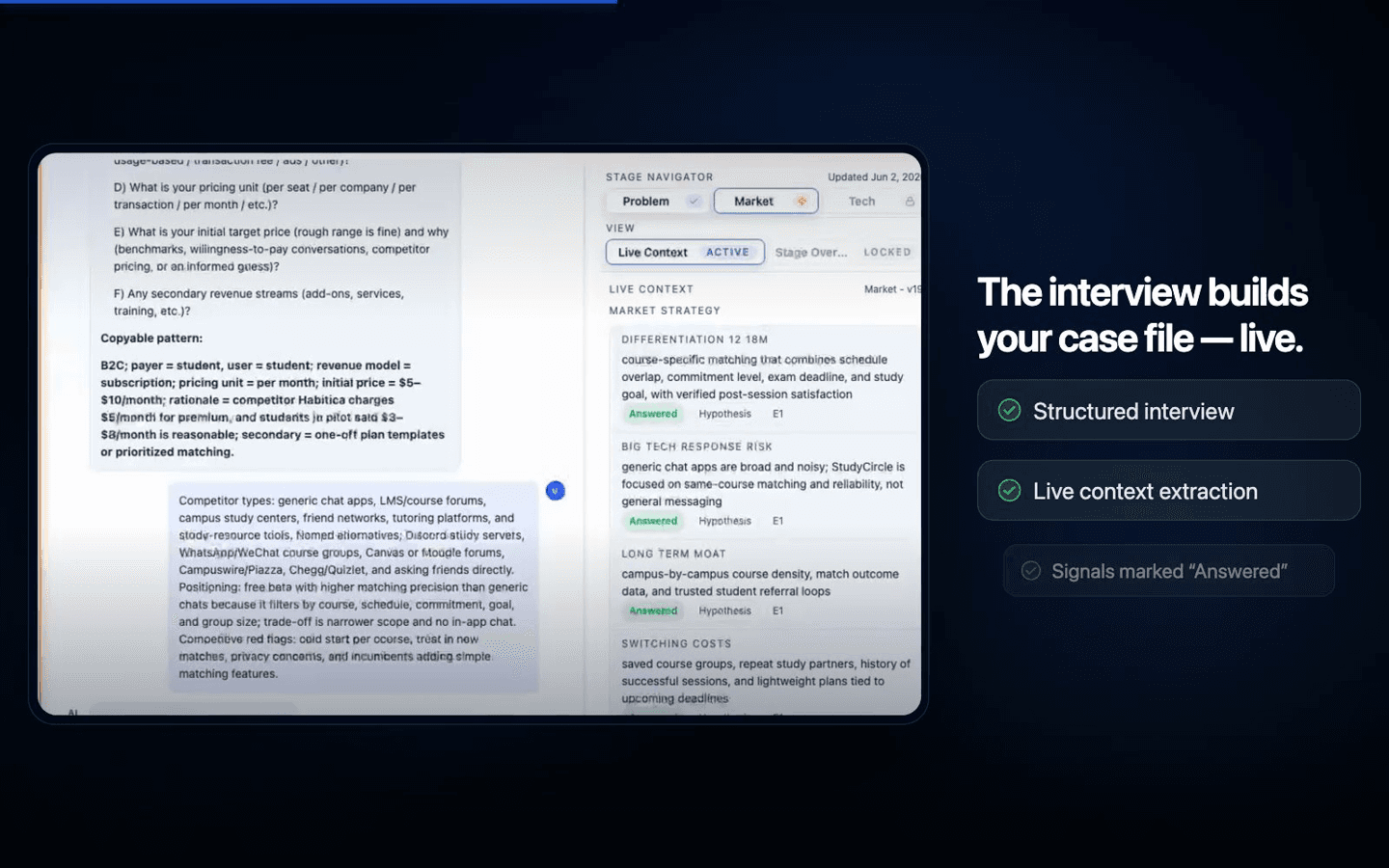
Perspective
Most bad bets feel persuasive right before they get built.
IdeaSense is designed to challenge the pitch, surface missing evidence, and slow down the rush to execution.
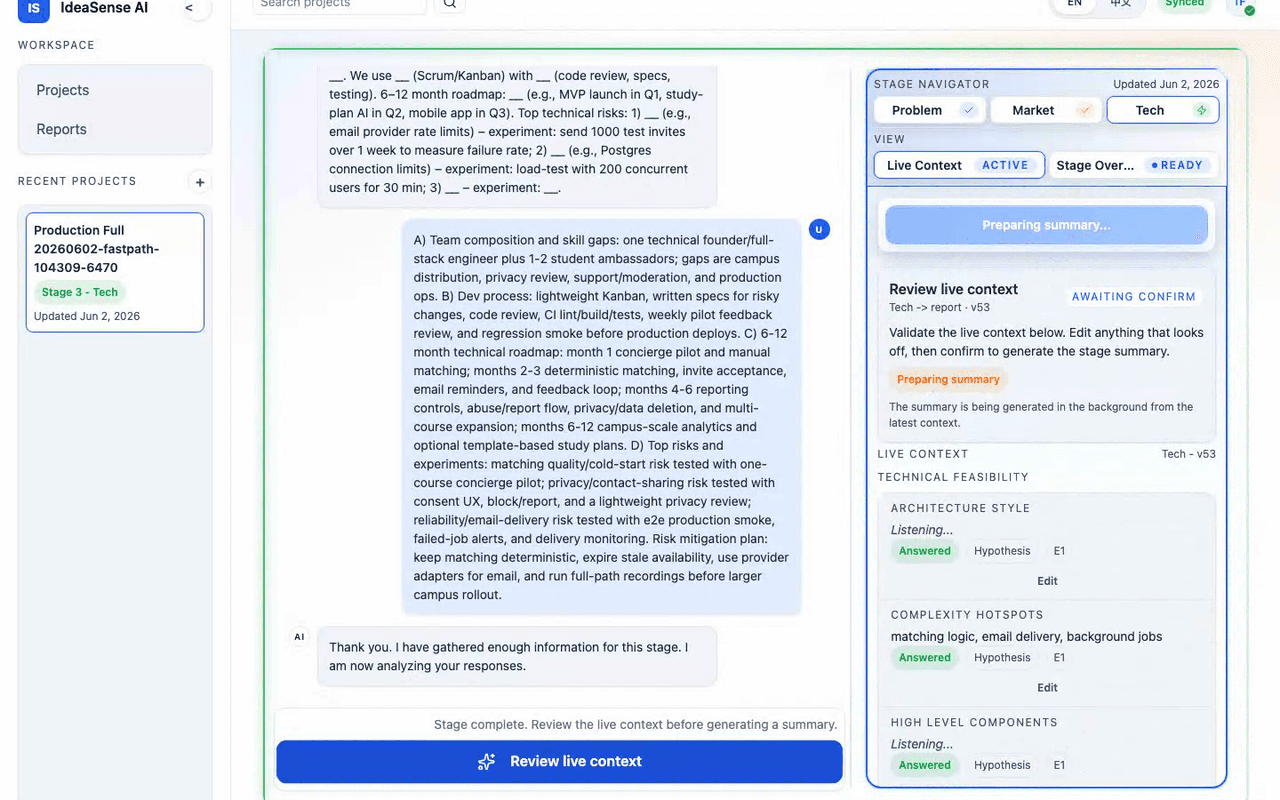
Real review workspace
DVF Engine
Three signals. One clearer decision.
Desirability, viability, and feasibility are reviewed separately so the result feels defensible, not improvised.
How it works
Not open-ended chat. A staged review process.
The conversation moves through structured stages. Each stage has anchors, a summary checkpoint, and a clear standard for what is ready to move forward.
Interrogate
Challenge weak logic
Anchor questions push on missing evidence, edge cases, and the assumptions you haven't tested yet.
Quantify
Turn intuition into explainable signals
Every answer feeds the live context: claims become hypotheses, and hypotheses become scored evidence.
Decide
Bring the most dangerous unknowns forward
The review ends in a decision, not a transcript — what to validate next, and whether to proceed at all.
DVF Engine
Three signals. One clearer decision.
Desirability, viability, and feasibility are reviewed separately so the result feels defensible, not improvised.
Desirability
We test the problem, the target user, the context of use, the urgency of pain, current alternatives, and whether real demand signals exist.
Viability
We examine the value proposition, business logic, market dynamics, channel friction, competition, and the assumptions behind commercial success.
74
Viability
Feasibility
We assess MVP scope, technical approach, dependencies, data and compliance constraints, team capability, and delivery risk.
The horizontal axis increases with uncertainty and the vertical axis increases with delivery impact. Positions show typical review priority, not a project score.
- 01MVP scope
- 02Technical dependencies
- 03Data & compliance
Illustrative positions — not project data.
Decision-Ready Report
A report your team can actually use.
Instead of another generic plan, get a concise decision artifact: score, risks, assumptions, and what to validate next.
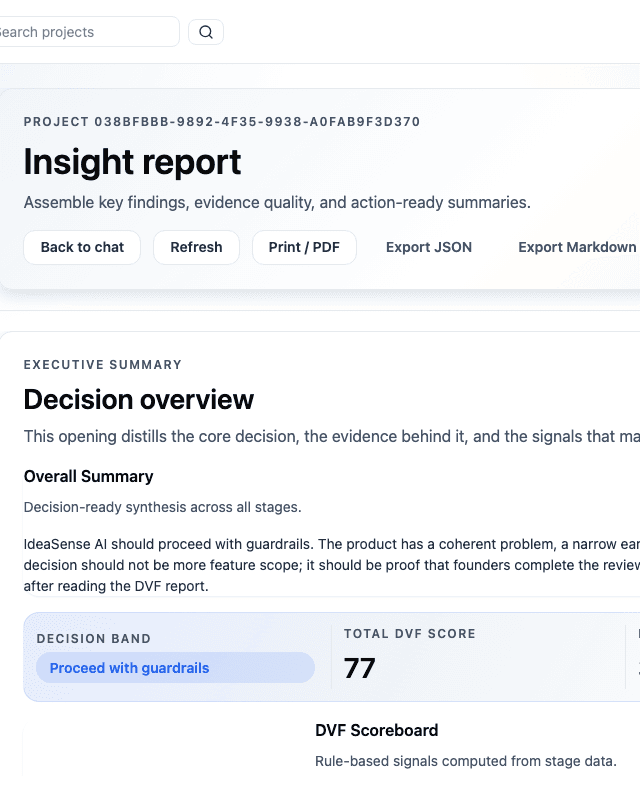
DVF scoreboard and overall decision band
Lean Canvas summary
Market evidence and verification summary
This report said “proceed with guardrails.” The site you are reading is what proceeding looked like.
Reports can be printed and exported for follow-up discussion.
Decision band
77/100
Proceed with guardrails: validate completion and report traceability first.

About
Built independently for founder reality.
IdeaSense AI is an independent product built and operated by Ethan Lu for early-stage software founders and solo builders who need clearer decisions.
Built for
Built for early-stage software founders and solo builders.
Session format
The system gathers the problem, user, scenario, proposed solution, and the assumptions currently carrying your confidence.
Core output
Lean Canvas summary
Independent product, open to feedback
If you work with founders or early-stage teams, product feedback and thoughtful questions are welcome.
Open registration is live, and product feedback goes straight into ongoing iteration.
FAQ
Questions, answered.
The short version of how IdeaSense thinks, scores, and protects the work.
ChatGPT is good at open-ended brainstorming. IdeaSense runs a staged review: anchor questions, summary confirmation, DVF scoring, and a report built from structured project state rather than a one-off chat response.
Start with evidence
Sharper evidence. Better bets.
Use a structured founder review, DVF scoring, and a decision-ready report to decide whether to proceed, pause, or pivot.
Open registration is live. Scores support judgment; they do not guarantee outcomes.